

Why Are Gen Z Students Choosing Entrepreneurship Over Traditional Career Paths?
Traditional classrooms and rigid corporate ladders are losing their appeal for the youngest generation of builders. Ambitious high schoolers are looking beyond theoretical lectures, choosing instead to launch real companies, develop practical tech skills, and take ownership of their professional futures before even graduating.
For these self-motivated teens, waiting until university to gain real-world experience feels like a missed opportunity. This shift is reshaping how young people view success, skill acquisition, and career longevity.
Why are traditional career paths failing to attract high schoolers?
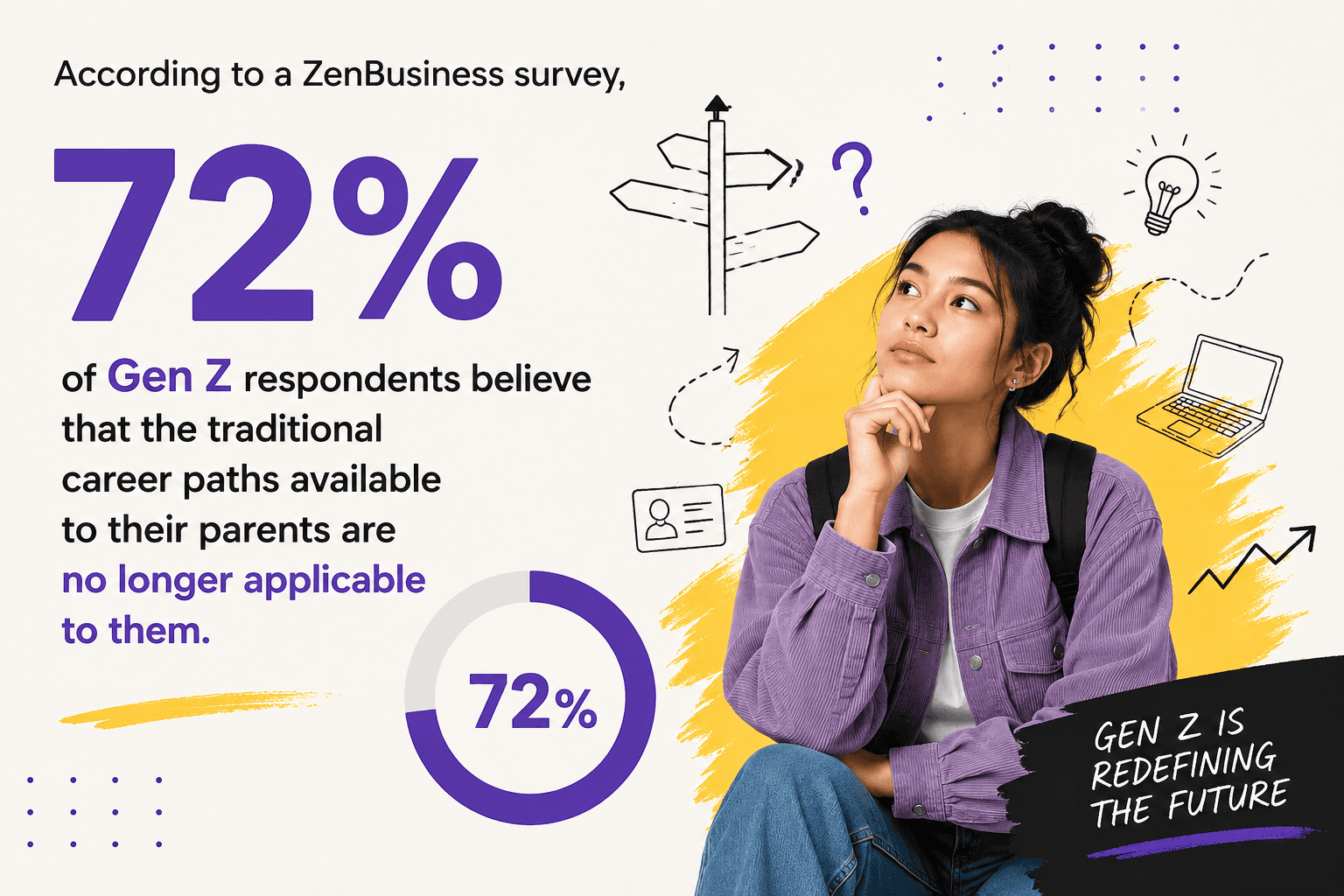
The standard trajectory of high school, university, and a corporate 9 to 5 no longer guarantees stability or fulfillment for the younger generation. According to a ZenBusiness survey, a striking 72% of Gen Z respondents believe that the traditional career paths available to their parents are no longer applicable to them (ZenBusiness via Medium). High school students today find school work overly theoretical and are eager to swap passive listening for real-world execution.
This skepticism stems from observing macroeconomic shifts, rising tuition costs, and corporate layoffs. Students realize that academic prestige alone does not build actual capability. They want practical startup, tech, and business experience early on so they can stand out in top-tier university admissions and future venture building.
What does the data say about the Gen Z startup wave?
The data confirms that teen entrepreneurship is growing rapidly. According to a LendingTree study mapping data into 2026, over half of Gen Zers (51%) have seriously considered starting a business (LendingTree). Furthermore, the share of young people aged 18 to 24 actively starting or running a business in the United States doubled over the past decade, reaching 25% (Laurie Stach).
This structural shift indicates that building a business is becoming a mainstream ambition for teenagers. They view entrepreneurship not as a distant adult goal, but as an immediate way to develop leadership, communication, and critical thinking.
What internal barriers stop ambitious teenagers from launching?
While desire is high, aspiring teen founders experience heavy emotional and practical roadblocks. A 2026 NatWest and Mettle report revealed that 40% of Gen Zers feel overwhelmed and unsure where to begin when starting a business (NatWest Group). The study highlighted that 31% cite a fear of failure as a major barrier, 30% worry about balancing a business with personal lives, and 26% fear managing every aspect alone.
Aspiring teen founders often lack access to an aligned global peer community and true industry mentors. Without a structured framework, balancing venture building with a demanding high school schedule feels impossible. The study concluded that clear guidance or a step-by-step plan is the top factor needed to give young builders the confidence to launch.
How does Stella act as a practical launchpad for self-motivated teens?
Stella solves these exact generational pain points by acting as a launchpad for self-motivated teens who want to move beyond theoretical learning and build something real. Whether students arrive with a burning idea they want to structure, or a strong instinct to become founders and need the right environment to discover their vision, Stella gives them a clear, step-by-step blueprint, from first concept to functional reality, designed to fit around a demanding school schedule.
The program bypasses traditional academic lecturing to prioritize direct execution. The focus is on real-world application: students leave with tangible skills in leadership, communication, and critical thinking, and the confidence that comes from having actually built something.
Who teaches the next generation of builders at Stella?
Stella is taught exclusively by real founders and active operators, not career academics who have never launched a company. Students interact directly with mentors and speakers from elite institutions like Harvard, INSEAD, Wharton, Oxford, Cambridge, and ESSEC, alongside global professionals from tech giants including Google, Apple, Microsoft, Amazon, Meta, and TikTok.
This network provides students with rare access to real-world knowledge and resume-building opportunities that traditional schools cannot offer. Instead of listening to abstract business theory, students learn exactly how modern tech platforms, growth frameworks, and product cycles function from the people who build them every day.
What proven venture-building credibility does Stella bring?
The framework used at Stella is backed by extensive, verifiable venture-building credibility. The ecosystem has co-created over 60 ventures, raised more than $60 million in funding, and accelerated over 200 high-impact startups.
This real-world track record ensures that the frameworks, financial templates, and growth strategies taught to teenagers are the exact models used by successful market ventures. Students do not just complete a simulated project; they enter a proven venture engine designed to convert early concepts into functional realities.
How did a teen founder build a real solution?
Consider the case of an ambitious 16-year-old student who arrived with a passion for software development but felt limited by theoretical high school computer science classes. Lacking a team and a clear monetization framework, they joined the Stella ecosystem, where they were matched with a technical co-founder from the global peer community and paired with a senior Meta product manager for direct weekly mentorship.
The result was the launch of an AI-powered micro-SaaS tool that automates scheduling for student organizations. Within four months, the venture successfully acquired 14 paid enterprise accounts, allowing the student to master real-world B2B sales dynamics and cloud engineering architecture well before university admissions.
Conclusion
The transition from passive student to active entrepreneur requires moving away from memorization and entering real-world application. Gen Z students are choosing entrepreneurship because they want control over their skills, their resumes, and their futures. By giving ambitious teenagers a structured blueprint, industry mentors, and a global peer network, Stella bridges the gap between raw potential and functional startup reality.
Parents looking to equip their children with durable, modern capabilities find that venture building develops self-reliance and critical thinking far better than standard testing. If a young builder is ready to stop studying history and start creating it, they need an environment built for execution.
Author

Guillaume Catella
Founder @ Stella
Guillaume has spent the past 18 years building startups and supporting founders across Japan, Singapore, and France. As a serial entrepreneur and former CTO, he's worked across Fintech, EdTech, e-commerce, gaming, and music. He founded Creatella, a venture builder whose team of 30+ has helped launch over 50 startups that raised a combined $50M+. Close to his heart is Creatella Impact, a charity he co-founded to accelerate 100+ early-stage women-led startups in emerging markets. Most recently, in 2026, he founded Stella, a new venture to bring his passion for entrepreneurship education to life. Guillaume also mentors founders through accelerators, INSEAD, and VC programs, and angels into early-stage startups when the right opportunity comes along